.

Showing posts with label Philippine culture. Show all posts

Folk Song Tuesday - Tao tao po  

Posted by Laya in , ,

For today's Folk Song Tuesday, let me share a song I learned in high school, called "Tao tao po." It refers to the old tradition of harana-- a young man who wanted to court a young woman would go with his friends to serenade her in the evening. Afterwards, they would be invited to come up into the house, maybe have some refreshments, and the young man could talk with the young woman, under the watchful eyes of her parents and family members. In this song, does the young woman dislike the young man... or like him too much?


Continue if you care...

An old love story and stuff like that  

Posted by Laya in , ,

It's been a while since I last posted -- yeah yeah I know, understatement much. I hope to have more time to blog now that I'm supposed to be on vacation. [What's rest, mama?] And more time to notice more interesting things to talk about and actually sit down and analyze them.

Anyway, since it's Valentine's Day, I figured it would be fitting to do this post.

You see,. I'm back at home, so I'm pestering my old aunt to tell me more family stories. For the first time, she told me how my great-grandfather won a princess for his bride. I've always known that one of my ancestresses was a binukot, but I didn't know who exactly.

According to my aunt, my grandmother --her and dad's mother -- was beautiful when she was young. Her father-- my great-grandfather, Tatay Mal-am-- was an encargado on a large estate in Iloilo, and had only two children, my grandmother and her brother. Before he was an encargado, however, he was a revolutionary, and he and his fellow members of the local Katipunan [where my grandfather's father's distant cousin, Teresa Magbanua, later rose to prominence] met and camped somewhere in the middle of Panay, where there were Sulodnon people, the so-called tumandok, the indigenous people of the island. The Sulodnon still carried on the practice of binukot-- the most beautiful women in the tribe were shut away from the eyes of the world, and they were never allowed to set foot on the ground. But Tatay Mal-am, so my aunt said, somehow made up his mind to win one of these princesses for his bride... so he went to the house of the woman's father and thrust his bolo into the foot of the stairs leading up to the house, announcing his intention to court her. He and his men often brought gifts-- meat of the wild boars they had caught, among others. Anyway, he finally got the father's permission to marry the girl he wanted.

The problem was that the village required the marriage ceremonies to be long and elaborate... he was going to marry one of their princesses after all. Tatay Mal-am, my aunt said, got fed up with all the hoopla and stole his bride away to the lowland, where he married her in a church. She was my great-grandmother, Nanay Mal-am. After the Revolution, he became encargado on an estate, and raised my grandmother and her brother in luxury. Aunt says that when grandmother was younger, and even after she married grandfather and had children, she liked to wear silk dresses and silk stockings -- in many different colors, each wrapped in tissue to prevent snags and runs -- and pretty shoes. Guess I know where I got that streak, huh?

Anyway, Tatay Mal-am wanted his precious daughter to marry someone he liked, and when he set eyes on my grandfather --who was fifteen years older than grandma-- he wanted him to be his son-in-law. Grandfather was then just a visitor to their town-- he ended up marrying grandma and moving in with them, since Tatay Mal-am wanted his daughter to go on living in luxury. Their oldest child-- my oldest uncle, the one we tracked down on Friendster after he left home over 30 years ago-- was born in the encargado's house, and my aunts spent their early childhood there. It was only after World War II-- a time when villages were warned by tambulis [carabao horns] that the Japanese were coming, and the people hid in bamboo thickets and cornfields until they had passed, for if the Japanese found anyone they would kill them--  that Grandfather brought his family back to his own hometown, and there my father, his youngest child, was born.


Continue if you care...

Sabi Ko Na Nga Ba, Nag-iisang Ikaw, Sayang Na Sayang  

Posted by Laya in , ,

So, random post for 11/11/11. What is it with today's date, lol. Feeling sort of nostalgic today-- and it's Friday after all-- so here are three songs from way way back when. I was in Grade Four when these songs became hits-- I know, because we kept singing them until we'd memorized them and they are the first pop songs I've ever memorized. Some may say they're old and sentimental and bakya, but the lyrics are beautiful. As usual, I provide a loose translation. "Sabi Ko Na Nga Ba" means "I said so" or "I knew it." "Sayang Na Sayang" is kind of hard to translate, because "sayang" can mean regret or waste, but the English words kind of fall short. Used in this song, it signifies regret for a love that had been thrown away.

Here are the lyrics of the songs  "Sabi Ko Na Nga Ba" (Sheryl Cruz), "Nag-iisang Ikaw" (Ronnie Liang), and "Sayang Na Sayang" (Manilyn Reynes) with translations in English.


Continue if you care...

The Friar's Daughter  

Posted by Laya in ,

I came across this book, and thought I'd share it with everyone. It's a really sad story. :( I think I can figure out who some of the characters really are, though.


Continue if you care...

Thoughts on the Maguindanao massacre  

Posted by Laya in , ,

The taxi I took last night to get home had its radio tuned to GMA teleradyo, and the driver was listening to the news. Just as we entered the traffic along Araneta Ave., Jiggy Manicad's report on the Maguindanao Massacre came on, where he interviewed Buluan Vice-Mayor Toto Mangudadatu, who had finally seen the dead body of his wife, one of those killed in the massacre. By the time I reached my destination, I was already crying from sorrow, anger and frustration.

“My wife’s private parts were slashed four times, after which they fired a bullet into it. They speared both of her eyes, shot both her breasts, cut off her feet, fired into her mouth. I could not begin to describe the manner by which they treated her," Mangudadatu said, trying to hide the tremor in his voice. "I cannot cry. I have to show my people that I am strong," he added.

Two of Mangudadatu's sisters, Bai Eden and Bai Faridah, were also killed in the massacre. One of them was four months pregnant. One of their aunts, Bai Manguda, was also reported to have been with them.

Aside from the Mangudadatu family members and relatives, the massacre victims also included two female lawyers, one of whom also had her elderly father with her, many journalists, and even some people who were on their way to Cotabato City to consult a doctor, and whose vehicles had gotten into or near the convoy when it was attacked.

According to news reports, Mangudadatu said that there were witnesses who had been able to escape from the convoy and who said that the attackers belonged to the Ampatuan clan, whose stronghold was the town where the attack happened. He also said that his wife had managed to call him over the cellphone and tell him of the attack, that the attackers were forcing them to rip up the papers they were to file with the Comelec for his candidacy, that the attackers were forcing them to even eat and swallow those papers, before the call was cut off. In one of the interviews of him after news of the massacre came out, he said that he had already been threatened with death if he filed his candidacy for the governorship of Maguindanao, the incumbent of which is an Ampatuan, and that the reason his wife went to file the papers for him was that he thought they would not dare to attack women.

He learned all too soon how high the price was of losing the gamble he made.

The massacre has provoked an outcry, not only within the country, but in the international community as well. Media watchdog Reporters Sans Frontieres has already called it the worst media killing in one day in the history of journalism, because of the number of mediamen who were killed, covering what would been an ordinary news event.

Perhaps the reason why the massacre has provoked so many reactions is that it hits so deep and touches on so many nerves. The senseless and brutal gunning down of so many people for the simple reason that they were trying to exercise the right to run for office in a democracy, because they dared to challenge an incumbent in his own stronghold, is one. Another is that many of those killed were women, one of them even a pregnant woman. Still another is that among the victims were lawyers and journalists, members of professions which are by tradition to some degree entitled to protection, one for its function as mediators and negotiators, the other for its function as recorder and reporter. Yet another is that even bystanders who happened to be in the wrong place at the wrong time became collateral damage.

Try as I might, I cannot begin to fathom the mindset that would perpetrate and even condone the commission of such atrocities. The manner of killing, as well as the treatment of the dead bodies, by the (said to number about 100) killers, displays such contempt, such scorn towards the victims as to show that they regarded the people they killed to be nothing more than pieces of trash to be thrown out and destroyed. What sort of people are they? Are they still human, at all? What manner of environment, of upbringing, even only of personality, do they have that they can commit such things the same way a mad dog singlemindedly attacks everything in its path?

Arguing for the sake of argument without all these statements necessarily being the truth, if all the rumors were true, if Mangudadatu's allegation concerning the Ampatuans were true, if all of these were for the purpose of teaching a lesson to an "upstart" who dared to challenge the king, then the twisted rationale to the Maguindanao massacre would be this:

A politician, wishing to extend his area of influence, decides to run for office in his rival's territory, and this rival, who has so far enjoyed unlimited authority in said territory, becomes incensed at what he views as an insult to his honor. Instead, however, of letting the election process run its course, he decides to nip it off at the bud by making the first politician abandon his plan. But the former is determined; come the day of filing for candidacy, he has a brilliant idea and sends to file his papers in his stead the people who by law and tradition are entitled to protection and safe-conduct: women, ambassadors, mediators and scribes. It was a good plan; had his rival been a more reasonable person, he would have acknowledged his loss in the first round. But no, the rival's anger grows even more. How dared they? How dared this woman come here on behalf of her husband, thinking to outfox him in his own den? Very well, if she would enter the field, she would then be a player, and she would learn the price that losers pay. Let all their deaths be horrible, so that no one would dare to challenge the king again. So he orders, and so his orders are carried out.

The rival, however, forgets that his "kingdom" has long since been a part of a democracy, and that he is in that position technically not because he belongs to a clan that has long been regarded as royal, but because of the democratic processes of the country where he lives, and that any misuse and abuse of power would hold him liable for his misdeeds to the people of that country.

Even if he were made liable, he thinks, they would have to come and dig him out of his fortress first. Who would dare? After all, this is his territory and he has friends in high places. He once got them out of a tight spot; he played a key role in getting them where they are now. Let them return the favor; if he goes down, so will they.


(That's why I should be writing fiction instead. I'm good at cooking up conspiracy theories.)

A great deal of the indignation we now feel at this is fueled by what we perceive as impunity granted to these monstrous killers to murder anyone who stands in their way. It is an indignation born of the knowledge that the common man is nowhere safe, that even the legal processes meant to protect them may also be their downfall if they do not have the money or influence to protect their rights. That it is always easy for one to earn a place in a cage when he is sufficiently non-entity enough. That on the other hand, one who deserves to be put in a cage can always avoid it or walk out of it at will if he had the money or influence. It is an indignation born of the realization that even monsters can go on a killing spree in broad daylight and their identities will be protected if they have the money and the influence with those who think they're the ones who matter. That in the end, the laws and legal processes of a democracy only work for the elite and not for the common man for whose benefit and protection they were originally intended and on whose backs, on whose sweat and toil, these elite built their empires.

It is an indignation that grows even more every time we read or hear words like these:

"Under the current government, the Philippines has become the most dangerous place in the world for media workers. At least 74 journalists have been killed during its eight-year tenure, yet the government has not acted to end the culture of impunity. At last count, only four convictions had been secured..."
(Being a journalist: one of the most dangerous jobs in the world.)

"an incident between two families in Mindanao... We cannot be affected by that… This has nothing to do with President Gloria Macapagal-Arroyo or the administration... If the public would know that we are sincere and that we are doing our best to give justice to the victims, I think that would vindicate us in case there would be impressions later on.”
(Why do you need vindication?)

“We don’t have full control of the situation on the ground, mortals as we are."
(...)

"If we use the iron hand on them, they might fight back. We should take precaution. These are not ordinary people."
(Weren't you quick to use the "iron hand" against the MILF and the Abu Sayyaf? Didn't the government fall all over its own feet to declare an "all-out war" in Mindanao? What makes these people different? Why are you so afraid that they will fight back?)

In the end, all we have are rumors that refuse to be substantiated, and this sorrow, anger, indignation and frustration that refuses to be assuaged. Wanna bet that after a while, all this will die down, and people will refuse to remember anymore... until the next, more horrific massacre occurs? And meanwhile the underlying problems continue, and the impunity remains.


Continue if you care...

Balita galing sa bayan kong sinilangan  

Posted by Laya in , ,

Every time I remember the recent killings in Maguindanao, it hurts a lot. It's as if a person's life were that cheap, that worthless, that it didn't matter. It hearkens back to our past. Every time we think that we have achieved a precarious balance in making peace on this island, something happens that reminds us how close that past still is, how near the surface the barbaric customs of not so long ago.

I thought the Mindanao depicted in the songs of Asin in the 1970s was beginning to fade. Has it?

The song "Bayan kong Sinilangan" was written by Saro Banares, who came from Koronadal, South Cotabato. Though it mostly refers only to one place, the song could just as easily refer to the island and its past.

The song "Balita" on the other hand is perhaps more familiar to people as its chorus was sampled by the Black Eyed Peas for its "APL Song." After over 20 years, suddenly it has garnered fresh meaning in the light of recent events. Sh*t. Still hurts.

Bayan Kong Sinilangan
(Asin)

Ako'y isinilang sa isang bayan ng Cotabato
Kasing gulo ng tao, kasing gulo ng mundo
Dahil 'di magkasundo sa relihiyon at prinsipyo
Nagkagulo
Ang bayan ko sa Cotabato, kasing gulo ng isip ko
'Di alam saan nanggaling, 'di alam saan patungo
Kapatid sa kapatid, laman sa laman
Sila-sila ang naglalaban, 'di ko alam ang dahilan ng gulo

Bakit nagkagano'n, ang sagot sa tanong ko
Bakit kayo nag-away, bakit kayo nagkagulo
Prinsipyo mo'y igagalang ko kung ako'y iyong nirespeto
Kung nagtulungan kayo, 'di sana magulo ang bayan ko

CHORUS
Sa bayan kong sinilangan, sa timog Cotabato
Ako ay namulat sa napakalaking gulo
Dahil walang respeto sa prinsipyo ng kapwa tao
Kapwa Pilipino ay pinapahirapan mo
Ang gulo

Ako'y nananawagan, humihingi ng tulong n'yo
Kapayapaa'y bigyan ng daan, kapayapaan sa bayan ko
Bakit kailangan pang maglaban, magkapatid kayo sa dugo
Kailan kayo magkakasundo, kapayapaa'y kailan matatamo ng bayan ko

Kung ako'y may maitutulong, tutulong nang buong puso
Gitara ko'y aking inaalay, kung magkagulo'y gamitin mo
Kung ang kalaba'y walang puso, puso na rin ang gamitin mo
Ituring mong 'sang kaibigan, isipin mong siya'y may puso rin katulad mo

CHORUS
Sa bayan kong sinilangan (bakit may gulo) sa timog Cotabato (sa timog Cotabato)
Ako ay namulat (kailan matatapos) sa napakalaking gulo (ang gulo)
Dahil walang respeto (kailan magkakasundo) sa prinsipyo ng kapwa tao (ang tao)
Kapwa Pilipino (kapwa Pilipino) ay kinakalaban mo (bakit kinalaban mo)
Ang gulo...

-----------------------
The Land of My Birth
(Original by Asin; translation by Laya)
INTRO


I was born in a town in Cotabato
As troublesome as people, as chaotic as the world
Because they couldn't agree on religion and principles
There was trouble
My hometown in Cotabato, as troubled as my mind
It doesn't know where it came from, it doesn't know where to go
Brother against brother, and flesh against flesh
They turned against one another, I don't know the reason for this trouble

Why did this happen, the answer to my question
Why are you quarreling, why did you create trouble
I would respect your principles if you respected me
If only you helped one another there wouldn't be such trouble in my home town.

CHORUS
In the land where I was born, in South Cotabato
I grew up amidst a great trouble
Because of lack of respect for the beliefs of fellow men
You brought hardship to your fellow Filipinos
Such trouble

I am making this call, asking for your help
Give way to peace, peace in my home land
Why do you need to fight, when you are brothers in blood
When will you agree, when will peace be achieved in my home town

If there were something I could do to help, to help with all my heart
My guitar I offer, for use in times of trouble
If the enemy has no heart, you should still use your own heart
Treat him as a friend, think that he also has a heart like you do

CHORUS
In the land of my birth (why is there trouble) in South Cotabato (in South Cotabato)
I grew up (when will it end) amidst such great trouble (such trouble)
Because of lack of respect (when will they agree) for the beliefs of fellowmen (of men)
Fellow Filipinos (fellow Filipinos) are who you're fighting against (why are you fighting them)
Such trouble...

----------------------


Balita
(Asin)

Chorus:
Lapit mga kaibigan at makinig kayo
ako'y may dala-dalang balita galing sa bayan ko
nais kong ipamahagi ang mga kuwento at
ang mga pangyayaring nagaganap sa lupang ipinangako

I
Ang lupang pinanggalingan ko'y may bahid ng dugo
May mga lorong di makalipad nasa hawlang ginto
may mga puno walang dahon
mga pusong di makakibo
sa mga pangyayaring nagaganap sa lupang ipinangako

II
mula ng makita ko ang lupang ito
nakita ko rin ng munting apoy sa puso ng tao
ginatungan ng mga kabulukan hanggang sa lumago,
ngayon ang puso'y may takot sa lupang pinangako

(repeat chorus)

III
dati rati ang mga bukid ay kulay ginto
dati rati'y ang mga ibon sinlaya ng tao
dati rati ay katahimikan, ang musikang nagpapatulog sa mga batang walang muwang sa mundo

IV
ngayon ang lupang ipinangako ay nagsusumamo
patakan n'yo ng luha ang apoy sa kanyang puso
dinggin n'yo ang mga sigaw ng mga puso
ng taong kung n'yong dadamhing kabilang sa inyo

V
duul mga kaigsuunan ug paminaw kamo
duna koy dala nga mga balita gikan sa banwa ko
gusto ko nga ipahibalo ang mga istorya nga nangakahitabu sa banwang gisaad nato


------------------
News
(Original by Asin; translation by Laya)

Chorus:
Come near my friends and listen
I have brought news from my hometown
I want to disseminate the stories
And the things that are happening in the promised land

I
The land that I came from is stained with blood
There are parrots that cannot fly, in golden cages
There are trees without leaves there are hearts that cannot move
Because of the things that are happening in the promised land

II
From the moment I first saw this land
I also saw the tiny flame in the hearts of men
Fueled by the corruption until it burst into flame
Now hearts are frightened in the promised land

(repeat chorus)

III
Once, the fields were golden
Once, the birds were as free as men
Once, only silence
Lulled to sleep the children who know nothing about the world


IV
Now the promised land is pleading
Drop tears upon the fire in its heart
Listen to the shouts of the hearts
Of men who if you would but feel are part of you


V
Come nearer my brothers and listen
I have brought news from my hometown
I want to disseminate the stories
That are happening in the land that was promised us.


Continue if you care...

Now that's a fiesta  

Posted by Laya in ,

I was recently invited to a fiesta in Bulacan. My roommates had been busy for weeks with the preparations and I had hardly seen them in our shared digs. Finally the preparations had been completed and the fiesta was in full swing. When I stepped down from the jeepney I suddenly felt as if I had been transported into a movie... one of those old movies where a visitor arrives for a fiesta and sees the marching bands go by, and the people in their best clothes greeting one another in the streets, and everybody goes from house to house partying till they're stuffed.

Of course we had fiestas where I was born and grew up. Those were mostly centered around the plaza, though. We usually had activities at the plaza every day and night for the whole week, usually basketball and volleyball tournaments and martial arts and synchronized calesthenics and dancing exhibitions. There would be a perya in the vacant field beside the plaza, filled with people at all hours, and if we were lucky, a ferris wheel. At night there would be beauty pageants and dances.

The last day and night of the fiesta would be the grandest. There would be a parade in the afternoon, with the school majorettes and drum and bugle corps leading it. There would be people from each purok with their floats... if it was a good year and there was money to spend, the floats would be trucks, if not, they'd be traysikads (bicycles with sidecars) or tricycles. The purok's princess, usually an elementary (aged 6 to 12) or high school (aged 13 to 17) girl, depending on the year's criteria, who has been picked by the people of the purok for beauty, talent, personality or popularity, or affluence, rode on the float with her escort, usually the purok's most personable boy of the year.

Although there will most likely have been beauty pageants the previous nights, the queen and princesses in the parade are not the winners of the pageants. They are selected by their puroks, and their families and neighbors then endeavor to raise donations for them in the form of money, which will be used to supplement the fiesta fund. The candidate who raises the most money becomes the queen, and the next four are her princesses.

I often took part in fiesta exhibitions when I was still in elementary school, as a majorette or a member of the synchronized dance or calesthenics exhibitions. My pet peeve though was not getting to be one of the princesses because my family didn't have any money, and on those occasions when someone approached my dad to ask if I could be the purok's princess he would always refuse. How I would look at the queen in her white gown with silver and gold embroidery and her long train that stretched out behind her for two meters and was held up by two little girls dressed just as beautifully.

The years passed, however, and my family's lot in life improved, so that my sister got to be a fiesta princess years later. Fortunately for me, too, when I got to high school our school principal picked me to become the school's princess for a fiesta, so I got to ride on a float and wear gowns after all. By then, I was already wondering why I wanted to do that sort of thing in the first place, lol. I had discovered that makeup made my face and neck feel sticky and that the heavy gowns made me feel hot and itchy. So much for wanting to be a princess!

Anyway, our fiestas were more about the plaza and all the presentations. As for the food, though, not everyone prepared fiesta food. Often, only the more affluent families did, and everyone just ate lunch, merienda, or dinner there. My own family only took the trouble to prepare fiesta food only when we were expecting guests from out of the barrio. Otherwise, we were all just busy preparing for whatever parts we had in the programs and were at the plaza most of the time. My mom would just cook spaghetti or pancit and a meat dish like afritada or pochero, and make macaroni salad, and perhaps suman and other kakanin, and that was it. Our guests ate lunch, went with us to the plaza and watched the presentations or played at the perya, and went back to our house for dinner before going home.

In Bulacan, the first thing I noticed was the sheer number of guests in my roommate's house. Neighbors, friends and relatives were there with their children in tow, and guests kept arriving and leaving. The house was dressed up to the nines and there was a buffet table on the porch groaning with food. At the side of the house was another table laden with drink, where the men stayed. People were also talking about the houses they had already visited and who was serving what dish and whether someone had cooked her specialty for this fiesta.

I also noticed a marching band passing by and naively asked about the route of the parade, since in our place, the band marches and plays only in the parade and in its presentation during the program that follows. My roommate laughed at me because apparently, in their place, the fiesta committee hires a band or "mosiko" that just goes around the barrio playing tunes. *facepalm*

The last guest finally staggered out the gate at nearly ten o'clock that night, laden with parcels of take-home food, and my roommate's mom said that it was time to unwrap the gifts. I was like, whoa, gifts? because I knew that it wasn't the birthday of anyone in their family. Apparently, it was customary for guests to bring a gift for their hosts. uh-oh. And I hadn't brought anything! So I just commented that I didn't know Christmas came early in their town, and they all laughed. The gifts usually consisted of household items, such as dishes, pots and pans, blankets, towels, and figurines or odd knick knacks to display. Well, I thought, now I know what to bring next time. If I'm ever invited back, that is.

But the day wasn't over yet, for we then headed to my other roommate's house (they're cousins), had a little midnight snack, and videoked into the wee hours of the morning. Wheeee. The next day, the whole place was strangely quiet as everyone recovered from the previous day's events.

Filipinos all over the archipelago celebrate fiestas, but apparently, we all have our little customs that vary from place to place. All I know is, if I ever get invited to another Bulacan fiesta, I should remember to drop by and buy some housewares.

Thanks to my roommates and their wonderful families for the invitation!


Continue if you care...

Another holiday on Sept. 7  

Posted by Laya in

Ah, Philippines. A nation of holidays.

Once again, our benevolent president has declared another special non-working holiday, this time on Monday, Sept. 7, 2009, for the funeral of Iglesia ni Cristo leader Erano Manalo. This, following two long weekends in August, Ninoy Aquino Day being on August 22 and National Heroes Day on August 31.

The last time a non-working holiday was declared for a funeral was not over a month ago, when former President Cory Aquino was buried on August 5, 2009, amidst a massive outpouring of grief and support not seen in the country since the funeral of her husband in 1983 and the EDSA Revolution in February 1986.

Meaning no disrespect to our kababayans who are members of the INC, including my own beloved sister and brother-in-law, but I just had to ask this: When did the Iglesia ni Cristo become the de facto national religion of a country which has a policy of separation of church and state? Inter alia, was the late Erano Manalo really the President of the Philippines and we didn't even know it?

Perhaps, to avoid congestion of traffic during the funeral procession, the declaration might be justified in Metro Manila or at least in the areas where the funeral will be held or will pass through. But in that case, they might as well declare the Feast of the Nazarene a non-working holiday in Manila and the surrounding areas seeing that the procession blocks traffic for miles on end every year.

But to make it a holiday throughout the entire country? For the funeral of a person who established a church of about a million or so members in a country with a population of 60 million? Meaning no disrespect, just stating the facts here. How politically correct (or maybe just politically ambitious) can you be? I now remember that proclamation of the special (but working) holiday for the anniversary of the Iglesia ni Cristo on the date of this year's SONA. Uh, come to think of it, was the 107th foundation anniversary of the Philippine Independent Church (Aglipay), the church that today is said to be the most tangible remnant of the 1898 Philippine Revolution, with a population of around two to six million, ever given any official commemoration last August 3?

Also, according to Press Secretary Cerge Remonde, flags will be flown at half-mast for Manalo. Which just makes me ask again, when did Manalo become President of the Philippines, or Vice President, or Chief Justice, or President of the Senate, or Speaker of the House of Representatives? When did the National Historical Institute declare him as one of those persons for whom the flag may be flown at half-mast? Hello, NHI. You made a fuss when Martin Nievera, according to you, didn't sing the National Anthem properly. Where are you now, when people don't follow the Flag Law properly? Oh, wait. Martin is "only" a singer, a performer, an entertainer. The one who ordered that Flag Law thing is allegedly president of this country!

Not to be nitpicking here, but let's just put things in their proper perspective, shall we? Hey, I must be crazy... I'm actually protesting the declaration of a holiday. It seems to me though, that there are too many of them nowadays, when we didn't even properly celebrate many of the ones we already have.

Following on the heels of that National Artist fiasco, this just goes to show... whatever honors you recieve in this country aren't worth the paper they're written on anymore. Anyone can receive the honors due a dignitary if he's influential enough.


Continue if you care...

Skewed priorities  

Posted by Laya in , ,

We reduce capital crime sentences for "good behavior" and let prisoners go free when in other countries they'd have rotted in jail for life. If their sentences can't be reduced, they are pardoned instead. Then we turn around and make a big fuss about opposition politicians who happened to take part in a parade and were assigned a vehicle with a toy machine gun.

If all smoke indicated a fire, we should all be evacuating our homes right now. But despite the blatant warning signs, or at least events and incidents that should be raising ginormous question marks in our minds, we choose to believe instead the excuses that it is all just a huge smokescreen. Far easier it is to believe that Nicole was not raped.

We make a big fuss about the murder of a PR man and his bodyguard, because the alleged mastermind is said to be a prominent opposition politician. Because journalists are not powerful politicians, 24 of them can be killed in the span of a decade and some narrowly escape being killed with impunity, and deaf ears can be turned to cries for justice for their deaths.

We deplore the rising birth rate and poor health of our people, but refuse to allow basic family planning methods and devices because they are immoral. Unhygienic, malnourished, unemployed citizens are not immoral, presumably.

We rarely get salary raises and are granted loans with great difficulty although we are religiously deducted some portion of our salaries every month for social security benefits. While we struggle and sweat for every penny, the money for our benefits are now proposed to be given to those who are unemployed, presumably as welfare checks (what else do you call them?).

Speaking of paychecks, we are religiously deducted a sizable amount of taxes each month and have to pay VAT too. What is left can barely get families through their basic needs and let them send their children to public school, while our politicians amass luxury cars, send their children to exclusive schools or abroad, and vote to raise their own salaries as well.

And on the home front...

"Makakain mo ba ang prinsipyo? Makakain mo ba ang hiya? Mamamatay ka lang na dilat ang mata kasama ng prinsipyo mo."

(Can you eat principles? Can you eat shame? You will only die with your eyes wide open together with your principles.)

"Bakit mo gusto yang kursong yan? Walang pera diyan! Magnursing ka at nang makapag-abroad ka at kumita ng dolyar!"

(Why do you want to take up that (college) course? That won't earn you any money! Take up nursing so that you can go abroad and earn dollars!)

Some parents teach their children that honor, principles, ideals and dreams don't matter in the face of expediency. That it is more shameful to struggle for what one believes in than to compromise one's integrity to live an easier life. That it is more humiliating to one's family that one's child pursue a path s/he chose for her/himself, no matter how hard, than that that child should labor in a field s/he does not really want for the sake of the almighty dollar. Sometimes, even, a daughter's honor does not matter as long as monetary compensation is given for it, for after all honor once taken cannot be restored, while money may be put to use, even if only to purchase some temporary luxury.

This is a country where some parents neglect to feed, clothe and educate their children properly, yet have money to throw away on gambling, alcohol and cigarettes. This is a country where the children of officials get to use airports as their own private driveways. This is a country where people who feel superior may berate an employee who is just doing his job and force him to humiliate himself, then pass it off as artistic temperament.

And we wonder why we seem to be going to hell in a handbasket.


Continue if you care...

Beware this taxi!  

Posted by Laya in ,

Night Shift Taxi, TXL 629.

I took very careful note of that name and number.

That was the taxi whose driver refused to turn on his meter. I had just left NAIA Terminal 3 after a flight from Gensan, and it was about 5 pm. Because airport taxis usually charge P500 and above if you hire them at the terminal, I usually get a taxi out front. Heck, using the taxi meter, the maximum fare from the airport to where I stay in Sta. Mesa is below P150! The driver asked me where I was bound and when I said Sta Mesa, he nodded and opened the door. Only when the taxi was moving away from the terminal, I noticed that the meter was not on, so I told him. He said that the practice was not to use the meter when picking up a fare from the airport, but that the standard fare to Sta Mesa would be P350. This despite the huge sign just outside the airport terminal that said taxis should use their meters and that contracting fares was forbidden. When I told him so, he did me a song and dance about how passengers should understand that taxi drivers were losing money because the fares were too small, and I firmly told him to let me off at the nearest gas station, after, of course, noting down his taxi name and number.

I had taken taxis from that point before, and was usually given by the guard a form with the taxi's name and number on it, as well as hotline numbers to report transgressors. The guard in this instance was chatting to other drivers and neglected to give me any such form. Fortunately, I kept a copy of that form at home and reported the driver to the hotline.

That driver had the ultimate gall to even intimate that I was inconsiderate for not giving in to his demands, even when he was the one breaking the laws. He said that the fares were too low, that drivers could barely feed their families, that the distance was too far (hello, airport to Sta Mesa, doesn't even take an hour if the driver knows shortcuts!), and finally, that he had already paid P50 to be able to wait in line at the terminal and that going by the meter wouldn't even make him back his boundary. Now don't that beat all.

First of all, Manong, it's not your passenger's fault if you paid P50 to anyone so you could go on chiseling your passengers. You shouldn't even have been made to pay anything because there wasn't any regulation at that area and if anyone asked you for money that would have been extortion. Just as you asking for P350 for a fare that cost less than 150 is also extortion.

Second, you are not the only one with woes. We are all living in this Godforsaken country, struggling to get by. We are all burdened with rising prices, with low salaries, with high taxes, so what the Goddamned hell makes you think you're special? I pay rent, electric bills, water bills, and fares. I buy groceries and food. I'm on a budget too. You should not have thought that just because someone takes your taxi instead of a bus or a jeep, he could well afford to pay higher fares. You should not have thought to cheat your fellow man, period.

Third, just because someone comes from the airport and presumably could afford an airline ticket, doesn't mean he has money to burn. I only scraped together enough for my economy fare home to attend my sister's wedding and my budget was already tight enough that I would be pinching my pennies till next payday without you trying to pressure me to pay you more than you ought.

Fourth, I well understand the plight of the drivers. I often add a tip when taking a taxi. But only to those drivers who don't ask me for anything and who show the right attitude. Asking someone for more money without even rendering good service or any service at all? Don't bullshit me. For your information, the meter of the taxi I took after you dropped me by the roadside amounted to only P132.50... I didn't even ask for change back from my P150.

I hope that anyone who reads this will be wary if they encounter this taxi driver in the future. And you, Manong, as we say... Makarma ka sanang bwisit ka!


Continue if you care...

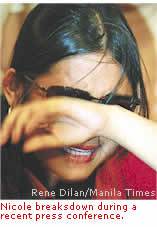
What happened, Nicole?  

Posted by Laya in , , ,

(an open letter to "Nicole" of the Subic Rape Case)

What a Women's Month gift you gave us, Nicole.

After obtaining a conviction in your case, after everything, you suddenly threw it all away. Little by little, you had been working towards victory. He was convicted. He was not being held in our jails, true, but people were working on that. You had faced the public brouhaha the case engendered. You had been through the innuendoes, the malice and the rumors. You were nearly out of the tunnel, Nicole. Then you took it back. Your statement admitted you had behaved improperly, that perhaps you had been mistaken in what happened.

What does it look like now, to us? The newspapers say that you took the 100k he offered and emigrated to his country. They say that you went to join one of his countrymen. We feel betrayed.


I feel betrayed. I had viewed your case as something quite close to the one in "Inherit the Wind." You were a symbol to us of all our countrywomen who had been oppressed by foreigners simply because of our nationality, and far greater insult, this time the oppression had occurred on our own native soil. Would we let the foreigner get away with it? Of course we needed to show that we are not the pushovers they take us to be. We needed to show that the Filipina, despite her submissive reputation as a domestic helper, as a mail-order bride, even as a prostitute, also had dignity and was entitled to respect. Since you were the one involved, you became that symbol, Nicole.

In the end, you stood for none other than our own motherland, which in the words of the song:

"...pag-ibig nasa kanyang palad,
nag-alay ng ganda't dilag,
at sa kanyang yumi at ganda,

dayuhan ay nahalina...

bayan ko, binihag ka, nasadlak sa dusa."


(Love was in her hands,
she offered beauty and splendor,
and because of her gentleness and beauty,
the foreigners were attracted.
My country, you were taken captive and plunged into despair.)

Did it ultimately prove too much for you, Nicole? Did you just want to shout that you cannot be the statue on the pedestal that everyone wanted you to be? Or did you not realize how great a symbol you had become?

A friend of mine says that perhaps you were not strong enough, that was why you gave up the fight. She says perhaps if you had a more activist mentality, perhaps if you had been more idealistic, you might have seen the fight through to the end. As it was, she said, like most of us maybe you just wanted to give up. After all, "what justice could there be in this country?"

Others are only all too ready to heap blame upon your head for your acts, saying that since by your own admission, you were promiscuous after all, you deserved no respect and you proved it by skipping out on the rest of us. Some think that you were all too ready to give up the fight for a little money and the golden opportunity to emigrate to the "land of plenty." Implying, of course, that you are really just no better than the gold-digger which some people in other countries label us Filipinas to be-- all too ready to lie down and spread her legs for a little cash, long devoid of any inherent dignity. And that image does not help us at all.

Why, Nicole, why?

I do not know you as a person. Still, I do not want to condemn you for what many of our other sisters have done by reason of poverty or external pressure. Our country has long rationalized many acts in the name of personal prosperity-- how else would it attain the level of corruption the world perceives in it? We know the concept of "kapit sa patalim" (cling to the knife)-- the justification why so many of our countrymen leave the country to work in other places, no matter if they are overeducated for the job, just as long as it pays better. It takes a person with backbone to stand against that concept, to refuse to be one of those who subscribe to it.

I know too, how in this country things can be deceiving on the surface. I know how innocence can be twisted till it looks the very picture of guilt. I know too how guilt may be whitewashed till it looks the very image of innocence. I know how great a role money and influence play in those transformations, especially when it comes to politics. I know how this can subvert truth till it cannot be found anymore. Which is why, in the face of all the recriminations being laid at your door, even in my disappointment I do not want to judge you, Nicole.

What happened, Nicole? Only you know the truth... but then again, when it comes to this country, does anyone ever know the truth anymore?


Continue if you care...

Murphy's Law and Disasters Waiting To Happen, Or, The Princess of the Stars Tragedy  

Posted by Laya in , ,

So wrapped up in trying to get a website online, we didn't even notice there was a storm brewing. We managed to get the site up 30 minutes before quitting time on Friday, June 20, 2008, then rushed home ahead of the gathering rain. At approximately the same time that my co-workers and I left the office, a ferry had left port a few kilometers away from our workplace in Quezon City and was making its way out of Manila Bay towards a fateful rendezvous with death. I was glad the next day when the heavy rains gave me an excuse not to render Saturday overtime, inspiring me to sleep late and not even turn on the TV. A way to compensate for nearly three weeks of uber-overtime including whole weekends. It was Sunday when I tuned in to GMA News and saw the newsflash-- San Fernando, Romblon mayor Nanette Tansingco's radio interview, where she said that she had sent their municipal Chief of Police and members of the Bantay Dagat in a speedboat to verify the wreck "nakita nilang may nakataob na barko may butas sa gitna (they saw a ship belly up with a hole in the middle)" but they couldn't get near it because of rough seas and almost zero visibility.

The ship was the M/V Princess of the Stars-- Sulpicio Lines' "flagship". Supposedly with a capacity of 1,992 passengers, it was carrying only a little over 800 people when it crossed the path of a meandering Typhoon Frank near Sibuyan Island, Romblon at noon on Saturday, June 21, 2008. According to the few survivors, it was all over in 15 minutes. They described waves as tall as mountains (mas malaki pa sa simbahan), saying that the ship slowed down and began to tilt. It was noon and lunch was being served when the order came to abandon ship. Of the more than 800 people on board including about 50 children and infants, only about 57 lived to tell the tale.

Much has been written and continues to be written on the "culture of disaster" that seems to permeate the Filipino way of life -- fatalism, belief in Divine Providence and fate, "bahala na". With the Princess of the Stars, and, it seems, as with all the other ferry disasters this country has endured, Murphy's Law always caught people at their weakest and most inattentive times. If I remember correctly, the M/V Vector smashed into the Dona Paz in what came to be considered "the world's worst peacetime maritime disaster" when, it was said, the tanker's crew were napping, watching television and drinking beer. Such inattention to duty, accompanied with sheer overloading and the desire to turn a profit on the side of the powers that be that made the Dona Paz possible (would it be rude to call it greed? :P), cost over 4,000 lives-- nearly four times the death toll of the famous Titanic-- and made the Christmas of 1987 one of the saddest in this nation's history. This time, a ship was allowed to sail in disregard of a gathering storm-- a fatal miscalculation. Or was it a miscalculation? The word miscalculation denotes a mistake, an error. If you knew that grave danger was looming, would you still walk willingly into it, or would you try to get as far away from it as you could? What would you call the act of someone who would knowingly lead over 800 people into a dangerous situation? You'd not call it a mistake, but arrant foolhardiness, right?

Yet, so many do it, like the man who gambles his family's food budget for a month, on the risk of winning-- never considering that he may lose. Princess of the Stars was just this gamble magnified-- the gamble of bringing the ship in safe and on time (as if Sulpicio ships were ever on time). It was a gamble that should not have been made on the lives of people. It was a disaster waiting to happen. The shipping company called it an act of God. Instead, in view of the many ferry disasters that this company has been involved in in the past, and in view of all the lives that it has gambled with and lost to the deeps of the seas, I only remember one of our folk adages: "Kaisa, suyap. Kaduha, sipyat. Katatlo, katangahan, ukon gintuyo na. (Once is a mistake, twice may be a coincidence, but thrice is either foolhardiness, intentional negligence, or deliberate malice.)"

I never dreamed that the first articles I'd write for my new site, the one we'd just put up the Friday before, would be on Typhoon Frank and the Princess of the Stars disaster. As I read the news coverage and wrote my stories, tears kept trickling down my face to the chagrin of everybody in the office including myself. Tears of sorrow, of frustrated rage, that was all that I and everyone else could offer, all of us who ask: Did it have to happen?


Continue if you care...

A source of pride  

Posted by Laya in , ,

It's really a bummer when you google the word Filipino and most of the time the results are derogatory content. I was trying to write something about Philippine women, and when I googled the word "Filipina", there's this "Filipina 101" right on the first page of the search results, and it's an ad for a book that contains tips on how to court and marry a Filipina. Like Filipinas are commodities. You might ask, what am I so mad about when it could be viewed as a backhanded compliment that Filipinas are prize wives that's why there's a book specially written on how to "catch" one. Hello, is there a book entitled "American Woman 101"?

Anyway. I'm just glad there's Wikipilipinas and Filipiniana.net. That way, there will be web content about the Philippines that's not derogatory, for a change. Wikipinas and Filnet content are about the Philippines from the Filipino point of view. The sites try to present uncompromising content, content that says, here we are, we are Filipinos, we are human beings with unique and beautiful culture, all 100+ varieties of it, we live in a beautiful country the potential of which has not yet been fully explored. We are not just domestic helpers and mail order brides, japayukis, hospitality girls, seamen, construction workers, nurses and doctors. We are human beings who are trying to bear up the best we can in an environment that can be very hostile to us, and yet we have not lost our humor, our faith and our hope for a better world. We were an independent people who had a distinct culture before we were subjugated by a better-armed power who tried to make us forget who we are. But we assimilated their different cultures, and we survived. We live in a country that has many troubles, and yet we can still smile, we can still sing, we can still laugh. Would you have reacted the same way, were you in our place? We have to let our sons and daughters leave the country so that the rest of us might live. Condemn us for that if you may, but what would you have done, were you in our place? We may have burdens, but we love life so much that even when it deals badly with us, we still manage to embrace it. And see, this is what we have managed to do with it. We have produced great artists and performers, heroes, writers and scientists. We have composed great music, created beautiful dances, written beautiful literary works, painted masterpieces, developed scientific breakthroughs that benefit the rest of the world. We have concepts and beliefs that are not found elsewhere. Although many would disparage us saying that we cannot define ourselves, we accept that part of our mystique is our undefinability. We present us, as we are, a people as diverse as the 7,100+ islands we call home. Take us or leave us. We are as human as you.

Thank you, Wikipilipinas and Filipiniana.net, for each time I am there I find a new reason to be proud that I am Filipino.


Continue if you care...

Et tu, Brute? and things like that...  

Posted by Laya in , , ,

Congressman Jose de Venecia was ousted as Speaker of the House just after midnight today, Tuesday, February 5, 2008, and Congressman Prospero Nograles was elected Speaker in his place. What makes this ironic is that, in an earlier (failed) attempt to unseat JDV and install another Prospero (this one a lettuce, er, Pichay, what's with the Shakespearean names anyway?!?) in his place, Nograles reportedly claimed that JDV was his friend and that he would not "do a Brutus" on his friend.

Huh.


"Et tu, Brute?" Caesar gasped after being stabbed by the person he considered his friend in the Roman Senate.

What makes me snort (as in smoke coming out of my nose) is that on Monday morning, on my way to work, I heard over the radio (I think it was DZRH), one of the commentators in one of those "tambalan" programs say that JDV's goose was cooked since there already had been a celebratory dinner at the Arroyo house in QC the night before, complete with everybody slapping everybody else on the back and offering toasts all round. Wow. Talk of being sure of yourself. Well, they must've been pretty sure of their 174 votes if they were celebrating as early as Sunday evening. The commentator went on to speculate how much money changed hands and where it was from (kalahating milyon na naman?). Wow naman. Buti pa sila, ang lalaki na nga ng suweldo, marami pang perks of the job, tapos binibigyan pa ng kalahating milyon. Samantalang ang taong bayan, kumakayod ng kumakayod, halos kulang pa nga pambuhay ng pamilya, kinakaltasan pa ng kung gaano kalaking buwis. I wouldn't be so bitter about the taxes if it went to something tangible for the people. The problem is, we already know that most of the taxes we pay go into somebody's pocket and we get only the dregs as government services! Hello! Then I see that half-assed advertisement that mars my enjoyment of Channel 9's C/S shows-- "umunlad ang aking buhay" daw, pwe. So are we supposed to be grateful for government services? Hello ulit! Binayaran namin yan sa buwis na kinakaltas n'yo sa amin kada buwan! Wala kaming dapat na utang na loob sa inyo para sa serbisyo na binibigay ninyo dahil karapatan namin yan bilang mamamayan ng Pilipinas! Pwede tama na tong hacendero mentality na to?

That's what I call this sort of thing: hacendero mentality. I think historians and sociologists would also call it the "datu" system. You know, parang peon sa asyenda, kumakayod ng kumakayod para gumanda ang buhay ng hacendero, tapos kailangan pang mangutang sa hacendero at tanawin pa na utang ng loob yun, samantalang kung tutuusin yung serbisyong naibigay na nila ay hamak na mas mataas na ang halaga kaysa "utang" na yun. We Pinoys should've had enough of thinking that we are worthless, or that we are worth less than those whatevers that we often see on TV yelling at one another in Congress over who's going to get what. Kaya nga popular representation tawag dun eh. They are just our delegates! We put them there! So when we need something from them, we shouldn't think that they're going to do us a favor, because we are entitled to their services, damn it!

Anyway, ranting again. It's the result of reading Katherine Mayo's book "Isles of Fear: The Truth About the Philippines" on top of the ouster in the House. This book (published 1924) will be available on Filipiniana.net soon, so watch for it. Maaasar kang matatawang maiiyak. Tapos mapapaisip ka, is there a difference between what is depicted in the book and what is happening nowadays? Granted, exag ang book, not to mention the decidedly biased American viewpoint of the author, but if you disregard the pontification on how America is better and look at the facts and incidents as depicted, baka masabi mong nangyayari pa rin hanggang sa ngayon. Ang tanong: bakit walang nagbago? Ang sagot: aba, ewan. Tanong mo kaya sa mga unnamables sa Kongreso?

Where was I? Ah yes, the ouster. Nag-abstain si Darlene (Congresswoman namin) kaya no comment na rin ako sa mga nangyayari. Dog-eat-dog ang labanan --- so what's new? Bakit ako kakampi sa isa sa kanila, eh pare-pareho lang naman ang mga lintok, pinag-agawan na naman ang liderato para kung may gusto silang ipasa o ilusot, may backer na naman sila. Para malakas ang kapit. Oy, mahiya naman kayo sa mga taong bayan na naglagak sa inyo sa puwesto, gumawa naman kayo ng para sa kanila at yung hindi para sa mga sarili nyo! Kundi, mas gugustuhin na lang namin na mag-ubusan na kayo at ng mapalitan na! Peste!

****
Personal Ad: Notice my nice buttons at the upper right? Yeah, may links na rin sa Filnet and Wikipinas. Ang gustong humingi ng code, just drop me a message and I'll get back to you. Punta kayo sa sites ha? kita-kits!


Continue if you care...

In another culture... Part II: New Year  

Posted by Laya in ,

The custom of "pamamasko" lasted from Christmas to New Year and in some cases even up to the first Sunday of January, the Feast of the Three Kings. I felt awkward accompanying the family in making the social rounds of grandparents, aunts, uncles, great-aunts and great-uncles, cousins, godparents, and family friends, but everyone was really nice. I realized that I was witnessing in action another part of Filipino culture that I had learned about in school but had never really thought about: the legendary Pinoy hospitality that decreed that all guests are to be made welcome. The Tagalogs have it down to an art.


Even on New Year's Eve, my boyfriend's sister asked me to accompany her to take a cake to her ninang's house since she had not been there. I don't understand why they call "small talk" small when it could last for quite a long time! We ran back home at a quarter to twelve, yelling at the people along the road to wait until we had gone safely past before they started throwing firecrackers. The noise was quite deafening, though it was not yet midnight. And since this was Bulacan (Bocaue, Bulacan, could very well be the Fireworks Capital of the Philippines) the variety of firecrackers and fireworks was amazing.


My boyfriend had bought some whistle bombs, and tied them together in a string similar to a Judas belt (the names they think up for firecrackers!) Like all boys, he was looking forward to the great big bang they were going to make, and I didn't have the heart to rebuke him although I hate firecrackers and the nasty things they can do aside from making loud noises. The most I could hope for was that he would be careful. Tatay (what I call my boyfriend's father) had a boga, a sort of homemade cannon made out of a plastic pipe attached to the rifle he used for bird hunting (I swear, more people there had guns for bird hunting than I ever saw in Mindanao where I grew up, and I thought they said Mindanao was the violent place!). Tatay kept spraying the inside of the boga with this mixture of water and calburo, sort of like a modern version of the traditional Philippine bamboo cannon that used to be the symbol of the Filipino New Year, and Nanay kept laughing when all it made was a soft phut! instead of the loud boom that he was aiming for.


Anyway, at five minutes to midnight, the firecrackers were in full blast. We all gathered in the yard to watch the next door neighbors launch a spectacular fireworks display that Nanay heard had cost them over Php10k! Grrh, 10 thousand pesos for a spectacle that lasted only less than fifteen minutes, how many people could that have fed, I thought. The fireworks were great, though, great big blossoms of red and green and blue, and sparkling flowers and showers here and there. The people across the street launched a couple of Judas belts on the pavement, making us all shriek and run indoors as the firecrackers popped every which way and made an unholy din. In the interval, my boyfriend launched his string of whistle bombs. Then the neighbors retaliated with a bundle of kuwitis, and we finished it off with a couple of fountains.

Despite the ban on firecrackers (I hear that now they're going to ban everything that goes bang! and not just the very dangerous ones) we Pinoys think New Year is not complete without all the paputok. Must be a holdover from the very Oriental belief that loud noises drive away evil spirits. The Chinese used firecrackers for this purpose while the Arabs, according to one of my favorite stories, Eleanor Hoffman's Mischief in Fez, shoot off guns. (Mischief in Fez is no longer in print, they say--- I was lucky there was a set of Collier's Junior Classics in our library when I was in high school, else I would've missed out on a lot of great stories!) And what time is it more appropriate, rather, more imperative, to scare away evil spirits, than on the New Year?

We Pinoys make much of our New Year celebrations--- in fact, I have heard a lot of people say that they celebrate New Year better than Christmas (forgive the heresy!) . It's because New Year stands for a brand new start, where we leave all the bad luck and negative things of the old year behind and look forward to starting anew. In my family, it is customary to conduct a general cleaning (and I mean general cleaning!) of the house on the last day of the year. We wash and clean all the linens, do all the laundry, scrub the floors and walls, wash the windows, polish the furniture, etc. On New Year's Eve, we put all new linens on the beds and new curtains on the windows, and wear new clothes (preferably with polka dots, especially red or green polka dots). We make sure that there is nothing dirty left in the house, so that none of the "dirt", bad luck, negative things of the past year will be carried over to the new one. We put twelve varieties of round fruit in a special basket on the table, for good luck. (Nanay has thirteen, for more good luck; she also hangs a bunch of round fruits, like grapes, over the door, to invite money into the house!) We prepare a lot of good food, to ensure that we do not go hungry in the new year. We fill the rice bins and the food and spice containers, for the same reason. As midnight nears, we make all the noise we can make. We turn the stereo and TV up to the highest decibel (our power companies must love this holiday!), fire off our firecrackers and fireworks to chase off the bad luck, and open all the windows and doors to let the good luck in. We even start our vehicles, (cars, jeeps, motorcycles, etc., and rev the engines (the oil companies ditto!). We keep coins in our pockets (to invite in money) and jingle them; we also jingle coin purses and coin banks. Merchants and store owners keep the first sale of the new year separate and untouched until the next new year, as good luck tokens.

I guess, looking at it all now, we Pinoys need all the luck we can get, what with the state of our nation! Perhaps all of these New Year preparations are manifestations of our perpetual cock-eyed optimism--- no matter how bleak things are, we are still eternally hoping that with the start of a New Year, things might just change for the better.

Good luck to all of us, I guess!


Continue if you care...

In another culture... Part I: Christmas  

Posted by Laya in ,

Weeelll.... it was not in a foreign country. But never has it been so brought home to me how diverse the different peoples of the Philippines are, until I spent Christmas and New Year with my er, hum, biyenang hilaw, in Bulacan.

At home in Mindanao, during Christmas, we did have the misa de aguinaldo and karoling. I remember balking like a stubborn carabao when my dad ordered me to go visit my ninongs and ninangs on Christmas morning.. (I was a shy child and still get attacks of shyness at times even in adulthood... I am not at ease with people I barely know, even if they are related to me in some way. Just ask my boyfriend's mom how hard it is to coax me to circulate during occasions at their house!) As a child and all through adolescence, I thought myself fortunate that I had thoughtful ninongs and ninangs (almost all of whom lived on the same street) who remembered to give me a little something on birthdays and Christmas. Others rarely received anything from ninongs and ninangs except for the obligatory christening (or wedding) gift. At home, we didn't go out on the day before Christmas because my dad believed that we should all be at home helping with the preparations for noche buena. We'd then go to the midnight mass, come home to eat noche buena, then pretend to go to sleep. In reality, the adults (and the ones old enough to stop pretending Santa Claus was real) took turns slipping into the sala to leave their presents under the tree (all of them "from Santa" including the polished piece of rattan that my Dad always tagged "for the naughtiest"). Then, on Christmas morning, we all woke up to find that the presents had been sorted into different paper bags tagged with the recipients' names (one of my titas usually did it after everybody else had gone to bed). After all the presents had been opened, admired, and put away, my dad often had us pack up the remains of the noche buena and took us to the beach. Usually I brought my pillow with me and continued sleeping in the beach cottage until noon! Sometimes after we got home in the evening, friends and relatives came to call, but we didn't really expect anyone to make obligatory calls, so it was always a pleasant surprise to see who cared enough to visit.

Christmas in Bulacan was a different experience.

First, there were the namamasko. I woke up on Christmas morning to realize that kids were already waiting in a long line outside the gate, their faces eager in anticipation of goodies. Not only that, but every house they went to was supposed to give them something (usually a crisp twenty peso bill and I mean crisp!) Nanay (what I call my boyfriend's mom) doled out the twenties. For her children's inaanaks (godchildren) (my goodness! my darling was already a godfather before he was ten?!?) and her inaanaks, she also doled out presents and/or money apart from the twenties. Oh my gosh, I thought, I would've wanted to have been a child here, think how much I would've gotten for Christmas! Except that, think of the poor godparents! Now the cliche of the godparent hiding from his inaanak isn't that funny anymore. Luckily, my own godchildren are not so demanding, plus, most of them have wealthy parents so that giving them money for Christmas would've been laughable. Which now underscored another cultural difference between us. I don't know if it was just my family, but in our predominantly Ilonggo community back home, giving money instead of presents was, well, not precisely a no-no, it was just not done. Or maybe people back home didn't have that much money to give away, I'm not sure. Anyway, if we ever went pamamasko back home, it was usually strictly just to godparents and relatives, not the whole barangay.

Then, after the visiting kids had left, the whole family also dressed up for their own turn to go pamamasko! Now I know why most of the people in the family were so gregarious and socially adept. They were used to it from an early age, going to so many different houses and having to make polite conversation and all that. And I heard them comparing notes on who had already visited and who had not yet been by, who gave the best presents and who had the grandest noche buena. "Itong sina ____, sila na lang yata ang hindi pa namasko dine. Dinig ko kay ___ ay nadaan na sila duon, ay bakit napakalapit dine ay hindi pa tumuloy! (The family of ____, they are the only ones who have not been here. I heard from ___ that they went there, so why when we are only nearby, did they not think to come here?)" which brought home to me that these family visits were regarded as social obligations.


Continue if you care...

Ang hindi lumingon sa pinanggagalingan... Part I  

Posted by Laya in ,

Do you know who your father is?

That was one of the questions our "big boss" asked us, "big boss" being Gus A. Vibal or simply GAV, at Wikipilipinas.org. He said that most Filipinos don't know who their ancestors are. Who is your father? Where and when was he born? At what age did he get married? Where did he live? What did he do?

According to GAV, we Filipinos don't like to look back on the past. It's a sort of passive resistance to all those foreign colonizers... we choose to forget them. Myself, personally, I think it's because for us Filipinos, some memories may be too painful to remember. The problem with that is, we also forget the lessons we should have learned from the bad memories, and we also forget the good things that happened. Look at martial law and EDSA, for one. Twenty, thirty years later, the same thing may happen all over again because of our selective memories.

It reminded me of the time I got furious with my tita because she had my great-grandmother's silver keyring melted down and made into necklaces for my sister and me. She was so surprised at my reaction, reasoning that we could use necklaces but not a heavy, church-key shaped silver thing (who uses keyrings anymore anyway, she asked). What I couldn't make her understand was that the original ring, with its hand-etched design of a wreath of flowers and leaves, and my great-grandmother's (her grandmother's) initials (C. L. C., for Cristina Legada Cumoda) , originally intended to hold the keys to the family homestead, was worth more to me as a link to my great-grandmother and a family heirloom, than a silver necklace, beautiful though it may be. Now, it had become irretrievably lost, like so many other things about my family that we, as a dislocated branch in Mindanao, separated from the original clan in Iloilo, had lost or forgotten about.

That was why I am so keyed up about Wikipilipinas.org and its sister site, Filipiniana.net. They are repositories of Philippine history and culture, of the little-known everyday things that we have and take for granted, of the esoteric, of the painful things, of the good things, of everything that makes us Filipino. Filnet (the affectionate moniker for Filipiniana.net) has in its archives ethnographic studies by Dean Worcester and Daniel Folkmar on Filipinos during the American occupation, trying to classify Pinoys from most primitive to most civilized based on physical characteristics (a theory that went out with the 1900s); the original records on the infamous Andres Bonifacio court-martial and subsequent execution; novels written in Tagalog (and no, they are not popular Tagalog romances but fall into the realm of literary classics, the Pride and Prejudice, Wuthering Heights, and the like of Filipino literature); even Pinoy komiks (which take me back to my childhood when I devoured Aliwan, Espesyal, Horror, Funny, Extra, etc., by the armload). Wikipinas, on the other hand, is a repository of popular culture and common knowledge, of the things that we Filipinos have and take for granted but others don't know about, such as Philippine street food (I suddenly have a craving for ice buko, the kind with red monggo at the tip), and Philippine customs (like panunuluyan at Christmas) and even beliefs (I am Visayan by blood, so porya gaba!). Both sites try to capture the things that make us Filipino, things that we should not forget about our identity, and record them before they are gone forever, the way I should have done with my great-grandma's keyring.

After all, don't we Pinoys say (and we should be so good as to take it to heart) :

"Ang hindi lumingon sa pinaggalingan ay hindi makakarating sa paroroonan."
(He who does not look back at where he came from will not reach his destination.)


Continue if you care...

Quality affordable condos in Manila

Own an affordable Ayala Land condominium in the heart of Manila. It's located beside SM San Lazaro, a five-minute ride away from the University Belt and UST, and a stone's throw from LRT Tayuman Station.

Now pre-selling units in Tower 5.
Studio (22.4 - 23.49 sq. m.) - P1.6M - P1.8M
1BR (39.36 - 40.73 sq. m.) - P2.9M - P3.3M
2BR (45.49 sq.m.) - P3.5M - P3.8M
Loft (39.85 - 66.83 sq. m.) - P3.2M - P5.1M

For inquiries please contact Eva at
(plus-six-three)-nine-two-one-six-one-two-four-five-three-three
or email mhie(underscore)bate22(at)yahoo(dot)com


AddThis Social Bookmark Button
MeFindome.org: Homeless Cats & Dogs for Adoption