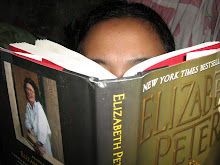
Don't take our books away!
Posted by Laya in book blockade 2009, iskolar ng bayan, personal, Philippine politics
Were it not for Robin Hemley's article, it seems, we would not have known that imported books might not be available to us in the future. (Backgrounder on the Great Book Blockade of 2009 here.) Reactions have been flying fast and furious. It seems everyone has put in their two cents and more... you only have to search #bookblockade on Twitter to see how people are reacting to this issue.
Robin Hemley has brought the issue to the attention of the AWP, but the Department of Finance is standing its ground on the matter, even daring critics to take the matter to court.
With the elections so near, and the reputation of customs for corruption, some people view the DOF's position with a jaundiced eye. There was, after all, mention of the need to fill a quota as the initial impulse for the imposition of a tariff on books. Add to that the now-famous lines:
"For 50 years, everyone has misinterpreted the treaty and now you alone have interpreted it correctly?" she was asked."Yes," she told the stunned booksellers."
-----------------------------
I spent my childhood in the back of beyond; my only friends were books and magazines, most of them foreign books, thanks to librarian aunts and the donations of the Asia Foundation that made their way to our distant province.
Those books were my window to the world that no one else in our small barrio saw or cared much about. I eagerly devoured The Black Tulip, Son of Black Beauty, The Crusader, and The Witch of Blackbird Pond along with back issues of Life and Reader's Digest. I accompanied Dick, Jane, Spot and Sally, and later Nancy Drew and the Hardy Boys, on their adventures, all while confortably ensconced in the old rattan lounger by the front window of our sala.
I might not have left my childhood home till late into my teens, but because of my books I had long ago traveled to Switzerland and Rome, London, Paris, New York and California. I might not have met other people outside of our small, tightly knit community, but I knew that the Dutch wore wooden shoes, that the Quakers were peaceable people, and that gypsies lived in wagons and traveled all over Europe. Those books may have been fiction, but they were an education in themselves.
My school used to enter me in those general info quiz bees, which I often won. That was the difference between someone who studied reviewers for the sake of winning a contest or acing an exam, and someone who read for the love of reading and learning.
Perhaps the weirdest victory I ever had was in the division quiz bee in the English language and literature category when I was in high school... my aunt got really mad at me the night before because I preferred to read Reader's Digest instead of going through the reviewers she had compiled for me. Among the articles in that issue of the Digest was one on Aleksandr Solzhenitsyn and the Gulag Archipelago, for which he won the Nobel Prize in Literature.
And the deciding question that won me the division championship in English that year was, surprise, surprise: Who was the Russian writer who won a Nobel prize for his book on concentration camps? My closest competitor, of course, looked at me disbelievingly when I gave the correct answer, for we certainly weren't taught about Solzhenitsyn in high school.
The next year, I again won the championship for answering correctly that the story of El Cid Campeador (Rodrigo Diaz y Vivar) was the epic of Spain (everyone else answered Don Quixote, which is a novel, not an epic, but which is probably the only Spanish work mentioned in our high school lessons). Again, that was because at home we had copies of excerpts from both books.
Whenever I got the chance to be in a library, I read. I used to volunteer to accompany my aunt to district teachers' conferences, just so I could check out the venue's library. She would ask the school librarian to let me use the library, and I would stay there, contentedly reading till someone came to collect me for lunch or to go home. Sometimes those books were dusty but showed no signs of use; a lot of children didn't bother to use the library or worse, weren't allowed in for fear they would damage the books. I certainly recall that I knew the libraries of the municipal elementary and high schools better than that of my own barrio school, because the latter was opened only once or twice in the five years I was a pupil there.
Were it not for those books, I would still be there, content to live my life bounded by the four corners of our town. Without the windows into a different world that those books had given me, I would never have known that there is still so much out there to be seen, known, felt and experienced. Without those books, I would long ago have succumbed to people convincing me that I was not good enough to go out there. Yet here I am now, and here you are, reading this blog from wherever in the world you are. Here I am now, still writing. Because of those books.
And they now want to take that away from us.
If the book blockade had been enforced decades ago, I wonder if I'd be where I am today.
Continue if you care...
I got it back only yesterday. It had been sitting in the pawnshop for the four years I have been in Manila, but I finally got it back. My graduation medal.
It is the season for graduation once again, and while we watch those whose turn it is to march this year, we remember the times when we ourselves made that walk and that bow.
This is my own graduation story.
I graduated high school in 1995. Four wonderful, adventurous years when we felt that all the world was ours and there was no limit save the preparations we made. And we rose to the challenge. Even now, in that small high school in the heart of Christian Mindanao, they remember the batch that graduated in 1995 as one of their best.
We took on everything. After the first-day fuss of June had died down, July brought the Nutrition and Health Month with its attendant competitions. August was Language Month, with its cultural and literary competitions. After those, the events came fast and furious. Future Homemakers of the
And we won. Not all the contests, of course, but we rarely if ever went home empty-handed. There was always a trophy to be added to the shelf in the principal’s office, a medal to be added to those hanging on the wall at home, a sash to be draped inside the cabinet. Those who know me now would never believe it, but I also took a turn in walking the ramp. It was a rite of passage for girls in the top half of the honor roll – walk the ramp in your junior or senior year at least once. I brought home a Third Runner-up trophy and sash, as well as a Darling of the Crowd award, from my stint in the provincial Bb. Agham (Miss Science) contest.
That was why, when it came our time to graduate, our class adviser decided to do something different. He decided to give his top five students gold medals for their graduation awards… not the customary “gold” medals given out all over the country, but real gold. And he didn’t tell us. All he said, when he gave the usual pre-graduation instructions on solicitation of medals, was that even if we asked our family and friends to donate medals for academic and co-curricular awards, we should not worry about the actual honor medals themselves because he would take care of that. And he did. He raised enough money to buy gold—local Mindanao gold, to be sure, but gold just the same—and commission a local jeweler to make the medals and their chains. They were tiny, of course, thumbnail size, but engraved with the torch and olive motif on ordinary medals. The rank determined the karat and the length of the chain. On Graduation Day, all gasped when, upon the imposition of the medals for valedictorian, salutatorian, and the three honorable mentions, our parents placed the necklaces around our necks.
It was the most valuable thing I ever owned. I used to wear it around my neck all of the time, inside my clothes, but later on I became afraid of losing it or having it stolen, so I put it away. When I came to Manila and decided to stay and find a job, I had to pawn it to pay the rent for a time until I was earning money. It took me four years to get it out of the pawnshop, but I didn’t mind.
That little medal is worth more than its weight in gold to me. It tells me that once upon a time, our teacher believed so much in us that he gave us a stake in our future, for he also told us that he intended our medals to be useful instead of mere decorations. It stands for a lot… a teacher’s pride in his students, a school’s recognition of achievement, my own belief in myself. It reminds me that I better be worthy.
Continue if you care...
(first of four parts)
I am proud to say that I am a product of the Philippine public school system. Since I grew up in a (relatively) remote province in the hinterlands of Mindanao, I was educated in the local public schools from kindergarten to college.
Our elementary school in our barangay had less than ten teachers because each grade had only one section made up of about 45 to 60 pupils. The class adviser for each class, in short, taught all the subjects in her class for the whole day, the periods for each subject marked only by putting away one textbook and opening another. If one had a textbook. We sat two by two on those small benches with a shelf that served as a writing desk for those sitting behind you, and often shared the textbooks, one to each bench. Lucky the child who got a book all to himself! Our teachers often asked us to discuss what we were reading, and to tutor our classmates who had trouble with their lessons. We took as much care as possible of those books-- we were required to have them bound and covered with plastic, and if you lost one, you had to pay for it. Forty pesos per book, in the late '80s and early '90s, was already nearly as much as the miscellaneous fees we paid each year (and some of my classmates were already hard up paying those fees)--- if you lost more than one... horrors! Frequent handling tended to weaken the glue binding and let leaves fall out, so we were required to have the book "bound", which meant boring holes in the spine with an awl then stitching it up with rough twine.
We were supposed to have a school uniform, but it was not strictly implemented. If you had one, you wore it, complete with socks and shoes-- if not, no one would call you on it. Not when some of the other children came to school dirty, ragged and barefoot. If they lived outside the barrio proper, they often walked several kilometers to school. Looking back on it now, I was one of the fortunate ones because my dad and other family members had steady jobs. I went to school in a uniform, including socks and shoes, and I got a new bag, paper, notebooks, pencils, and even crayons each June. I guess I was really a little brat, because my classmates kept stealing my pencils and paper and breaking my crayons-- back then, if you had the 16-color box instead of the 8-color one, and Camel instead of Colora, you were an object of envy, because the Camel colors were really vivid compared to Colora (no offense). Our school uniform was the requisite navy blue jumper (all public elementary school pupils in our place wore navy blue, distinguished only by little details such as the number of straps on the jumper), with wide shoulder straps connected to the waistline and one strap each across the back and front, and a white blouse with a baby collar (rounded instead of pointed ends) and puffed sleeves. We were supposed to wear white socks and black shoes with it, but most of the time, my classmates just wore white t-shirts and chinelas with the jumper. By the time I was in Grade Two, I had also opted to do the same, to my mother's sorrow. I even took off my shoes to participate in games, since my bare feet seemed to offer so much more traction while running than the soles of my leather shoes.
I was fortunate in that I often had new things at each start of the school year. Many of my classmates used the "butas-butas" or net string bags used at the market for school bags, and you could see the contents-- one tattered notebook, one pencil, ten sheets of pad paper. Oh, yes, and the "baon" or packed lunch. Few of them used plastic "tupperware" containers; more often than not, they just wrapped some boiled rice and two pieces of broiled tuyo in a banana leaf. Or sometimes, instead of the tuyo, a steamed eggplant and a dab of guinamos, or a boiled egg, or eggs scrambled with guinamos, or steamed eggplant fried with guinamos. Maybe it was being wrapped in a banana leaf that made it all taste better than baon carried in a plastic container, coz my mom was so mad when I wanted to bring baon to school in a banana leaf even when we lived only a block away from the school and had many tupperware lunchboxes at home. Sometimes, I brought some of my classmates home for lunch so that I could get at their baon because I was trying to figure out why their food seemed to taste so much better than what we had at home!
We didn't have a playground. I only knew what swings and slides looked like from books and magazines. There was a portion of the school grounds that was supposed to be a playground with swings, but all that remained were the upright supports made of metal tubes, which we often climbed on. We didn't miss having a playground, though. For an elementary school with only six classes, we had lots of buildings (most of them boarded up) and very extensive school grounds. We had vast lawns, concrete fences with corner blocks that invited climbing, and lots of plants and trees, including an ipil-ipil mini-forest, a banana plantation, flower and vegetable gardens, and wide cornfields. The fences were low, about four feet in height, except for the parts where the iron gates were attached. These had tall square blocks about seven feet tall on either side of the gate, and these blocks were about four feet square and hollow enough inside, like a miniature porch or crow's nest, to let one crouch down and not be easily found in a game of hide and seek. Other good hiding places were tree branches, the middle of several clumps of ornamental Chinese bamboo, the interior of the culverts in the ditch that surrounded the school, and tall grasses. Aside from hide and seek (panagu-ay), we also played "igo-ay", "chinese garter", "one and one", "langit lupa impiyerno" (heaven, earth, and hell), "bago-bagoong", "lantay-lantay", "shakay", and "pityaw", and had a lot of fun.
Recess time was 9:oo am; there was no recess in the afternoon. My daily allowance used to be one peso, most of my classmates had even less. I often bought a stick of banana-q for 25 centavos and a "cold-mix" or orange juice packed in a plastic bag, for another 25 centavos. Or an ice candy, or two boiled saba bananas, or a turon or maruya, at the same price. No sandwiches, burgers, spaghetti or pancit. At first my mom made me bring a glass of milk and a sandwich to school, but I liked buying food from the vendors, so she stopped giving me baon. The vendors only came to the school gate at around 8:30 and packed up and left at about 10:30, and we didn't have a school canteen!
We had such wide school grounds and no janitors, so we had to do a lot of maintenance work around the school. I think we spent about two hours a day on cleaning, like sweeping floors and weeding gardens and pruning plants-- we called it YCAP and until now I don't really know what that acronym stood for! (Clue: this was around the time of the first EDSA Revolution.) The hard part was harvest time. The school had cornfields, and hired someone to plant the corn, but we weeded and harvested it. It was a less onerous task for most of my farm bred classmates, but my family didn't have a farm, and I didn't have the least idea about farm work. I learned, suffering a lot of allergies, cuts and blisters in the process. After harvest, we husked the corn and dried it, then sold it in town. The fun part was that each class got their part of the proceeds from the sale of the corn, which we then used for activities like the annual Christmas party. The school vegetable garden was another matter; each pupil had his or her own plot in the garden, which he or she planted and took care of. When the vegetables were harvested, we each got our own share of the camote, gabi, talong, ampalaya or calabasa that we planted. Looking back on it now, I guess I took it for granted when I brought home a sack full of vegetables, but perhaps for some of my classmates those vegetables let them and their families eat well even when they didn't have any money.
There were many times when we didn't have school because our teachers were at conferences or were sick, and since there were so few of them, no one could take over someone else's class. We also often didn't have any proper lessons when there were scheduled events or festivities that we had to take part in, because the participants had to practice and the teachers had to take time from their classes to train and supervise them. Even then, our small barrio school bagged several top prizes in municipal, provincial and even regional events like the NAMCYA Choir Competition and the Speechfest competitions.
Now, looking at all those children going to school here in Manila with their yayas and their school services and their security guards and classrooms with electric fans and air conditioners, their elaborate uniforms and trolley bags and expensive school supplies, their big school canteens with a dizzying array of choices, their computers and playgrounds, I still don't know which of us had the more fun. I do know which of us spent less, though. Although many people would look down on public schools, especially a small barrio school like ours, I wouldn't knock the education I got there. I learned to work, to use my imagination, to make do with what was available, and to hone my skills without knowing what the competition was like out there.
(to be continued)
Continue if you care...
Quality affordable condos in Manila
Now pre-selling units in Tower 5.
Studio (22.4 - 23.49 sq. m.) - P1.6M - P1.8M
1BR (39.36 - 40.73 sq. m.) - P2.9M - P3.3M
2BR (45.49 sq.m.) - P3.5M - P3.8M
Loft (39.85 - 66.83 sq. m.) - P3.2M - P5.1M
For inquiries please contact Eva at
(plus-six-three)-nine-two-one-six-one-two-four-five-three-three
or email mhie(underscore)bate22(at)yahoo(dot)com
My site is worth
$2,027.35
Your website value?
Create your own visitor map!
Thanks for dropping by!
Who?
- Laya
- Manila, Philippines
- Poet. Writer. Editor. Wanderer. Bookworm. Shutterbug. Sketcher. Needlecrafter. Virtual Pet Owner. Gamer. Pseudo-Geek. Internet Denizen.
Categories
- personal
- Philippine politics
- PHAIL
- Philippine culture
- translation
- current events
- music
- philippine history
- Filipino culture
- women's rights
- philippine nationalism
- plurkiverse
- songs
- book blockade 2009
- entertainment
- iskolar ng bayan
- poetry
- proud to be a filipino
- subic rape case
- Globesucks
- books
- hayden kho scandal
- 2010 elections
- BB gandanghari
- Word of the Week
- politics
- travel
- women
- writing
My Other Home
-
Five Dramas That Are My Equivalent Of Comfort Food, Part 2 - So, yes, well. I've added to my "comfort dramas" list in the meantime. You know which ones I'm referring to... the dramas you tend to go back and rewatch w...13 years ago
-
Ampalaya-Pineapple Salad - *Gaaaha. I realized I have not posted here for a long time. I miss the ampalaya-pineapple salad my mom used to make, so I'll try to re-create it here. The ...16 years ago
Blog Archive
Spreading some blog love
-
-
-
There Is No Safe Space3 months ago
-
Panibagong Adjustment1 year ago
-
-
DECISIONS4 years ago
-
Wound ‘Round the Axle5 years ago
-
The Secret Corner6 years ago
-
TRESE Book 7 launch at MIBF 20196 years ago
-
Zwilling is Back in Megamall7 years ago
-
So I’m Bipolar7 years ago
-
Bookaholic Anonymous8 years ago
-
Why I Love My Family10 years ago
-
-
i have a new blog!13 years ago
-
New Book Blogger Has Moved13 years ago
-
-
Noble Phantasm has moved!16 years ago
-
just a quick update16 years ago
-
My New Obsession: Doodle Patterns17 years ago
-
-
-
-
-